
Use AI productively
Use tools such as Microsoft Copilot, Google Gemini, ChatGPT and AI-enabled business systems for useful workplace tasks, not just occasional prompting.
Build the people who can make AI, digital systems and workplace improvement useful, safe and valuable inside your organisation.
Employer-sponsored learners build practical capability in Next Horizon, then apply it back to their own role, team, department or area of influence while completing the nationally recognised BSB50120 Diploma of Business (Digital Transformation).
See useful workplace opportunities and learner progress during the program, not only at completion.
Prefer to review the details first? Download the Employer Information Guide
AI tools are moving into everyday work fast, and buying the technology is only part of the job. You may already be seeing signs of it:
The technology may be available. The capability to use it well may not be.
Start with a quick check. In about three to four minutes, see where your workforce appears strongest across seven readiness areas, and what to strengthen next.
Start with the work problem, not the next AI tool. The best improvement may be better use of a system you already have, a simpler workflow, automation, an AI capability already included, or no new technology at all.
Your people should be increasingly able to:
Use tools such as Microsoft Copilot, Google Gemini, ChatGPT and AI-enabled business systems for useful workplace tasks, not just occasional prompting.
Recognise where workflows, administration, handovers and recurring tasks can be simplified, connected or automated.
Question AI outputs, check evidence, recognise limitations and use human judgement before decisions are made.
Understand useful workplace data, identify patterns and use evidence to support better decisions.
Investigate what is really happening, find friction and repeated work, compare options and recommend practical improvements.
Understand privacy, security, governance, responsible AI and the boundaries around what should remain human.
Help colleagues understand new tools and processes, build confidence and move from uncertainty towards useful adoption.
Connect improvement work to productivity, customer and employee experience, capacity, cost, risk, quality and growth.
Short AI training can explain a tool. Organisations also need people who can connect AI to how work actually happens.
Participating employees complete the AI Workplace Transformation Program and the BSB50120 Diploma of Business (Digital Transformation) together, as one connected Learning Journey. The Diploma is awarded when all applicable training and assessment requirements are successfully completed.
The Program
AI, digital, automation and workplace improvement capability, built on realistic work inside Next Horizon.
The qualification
Nationally recognised, and assessed through the work employees do in the Program, as part of the same Learning Journey.

Shown with John Goodman, a demonstration learner.
Use AI and digital tools well and identify what could run better.
Investigate work, test improvements and show what changed.
Help others adopt better ways of working and recommend what should happen next.
These are stages of developing capability, not separate EduSmart courses or qualification pathways.
EduSmart develops the broader human, digital and business skills people need to create value in an AI-enabled workplace: 16 Future Ready Skills, applied across 12 capability areas. The skills are what employees build and prove; the areas are where they apply them.
Employees build and demonstrate these skills progressively across the Learning Journey.
Employees build a practical foundation before they apply it, working with leading tools rather than learning one platform in isolation:
Employees then step into Next Horizon, EduSmart’s immersive workplace environment. Instead of disconnected theory exercises, they work through realistic business challenges, systems, evidence, stakeholders and decisions across a modern Australian organisation, and are expected to investigate, build, test, improve and explain their work.
Employees work across connected business areas, which gives them a wider view of where AI and digital improvement create value across an organisation:
One practical improvement method runs through the whole program, so ideas become structured workplace improvement:
Across the Learning Journey, employees may:
These are examples across Next Horizon projects, not a checklist every employee completes in your organisation.
Employees build and demonstrate core capability using Next Horizon’s controlled workplace information. Employer-sponsored learners then apply the same thinking to the part of their own workplace they reasonably know, without needing to upload confidential operational information.
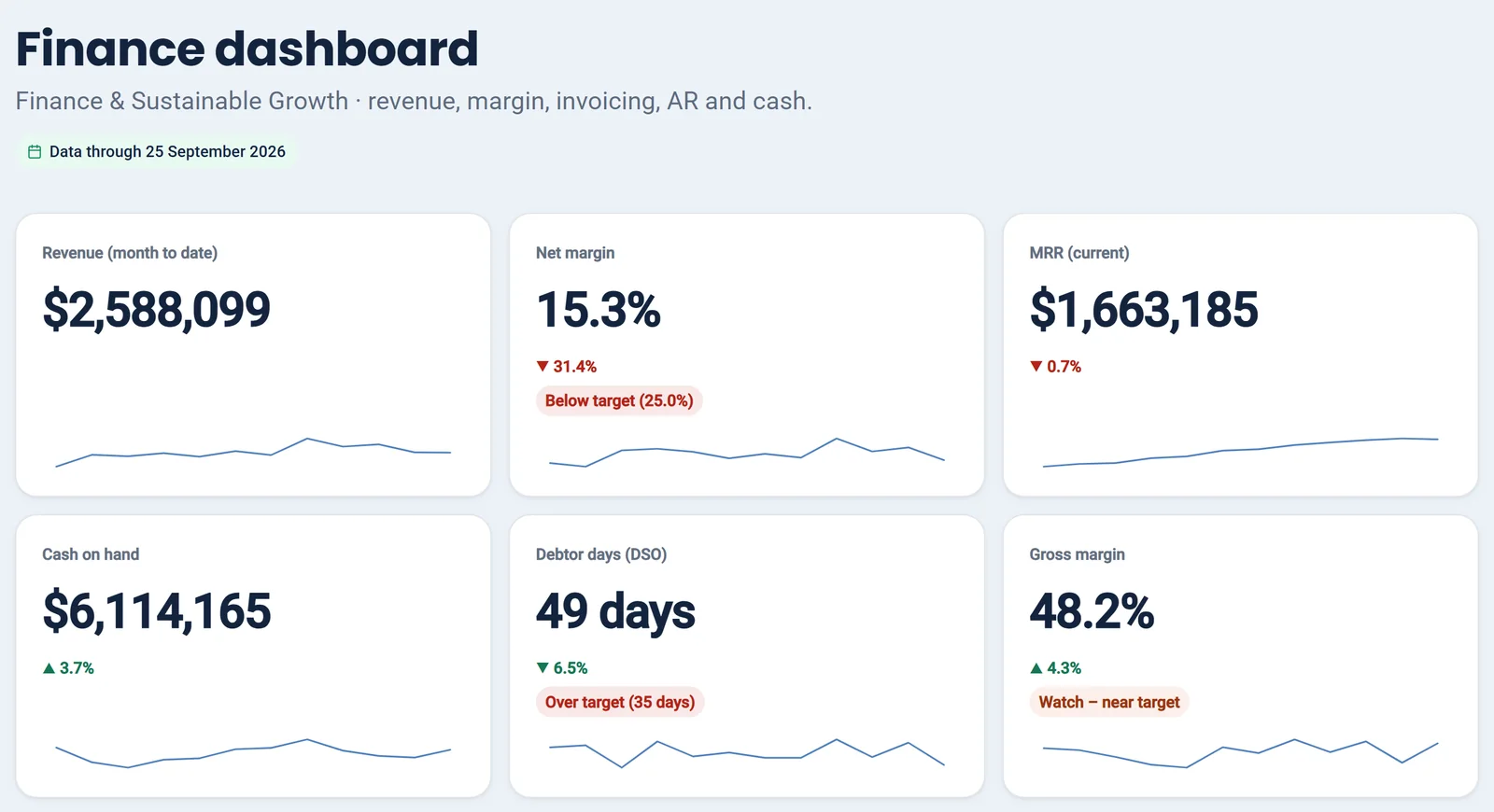 Over target
The workplace application is designed to create visible employer value without turning the learner into a consultant or adding another major assignment.
The learner applies the department lens to the part of your workplace they know and saves one worthwhile opportunity to a continuing Workplace Opportunity Record.
Short progress summaries can be reviewed after Digital + Operations, Client Success + People, and Risk + Finance, so managers do not have to wait until the end of the program for useful feedback.
At Head Office, the learner brings the strongest opportunities together, including existing tools that may help, where AI may add value, what should stay human, what still needs checking and who should be involved next.
The review is scoped to the learner’s role, team, department, process or area of influence. It is not an organisation-wide audit, implementation approval or final technology recommendation.
That gives managers more than a completion record. It gives them evidence they can discuss with the employee.
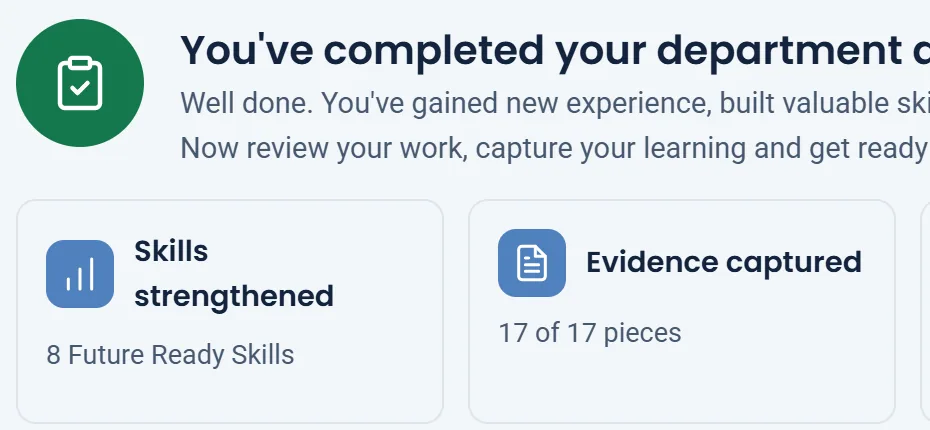
Shown with John Goodman, a demonstration learner.
Employees build practical outputs through their work. For employer-sponsored learners, that evidence is complemented by a continuing Workplace Opportunity Record and employer progress points. Outputs can contribute to:
The four Digital Achievement Badges
Badges are linked to demonstrated skills and practical evidence. They are not issued for watching lessons or attending sessions.
Traditional completion records can show that training happened. Evidence-backed recognition gives a stronger signal that the participant has actually used, applied and demonstrated relevant skills.
Each item in the Career Success & Impact Portfolio carries one of three labels, so a manager knows how much weight to give it: Verified by EduSmart (EduSmart tested it and determined the result), Checked by EduSmart (EduSmart checked the claim and the evidence supplied, and agrees) or Self-declared (the employee’s own statement).
The aim is to develop people who can increasingly:
The same core program builds capability for eight common workforce needs.
Build confidence and practical understanding so employees can participate effectively as AI becomes part of normal work.
Useful when your organisation knows AI matters but capability is uneven or still at the experimentation stage.
AI readiness is not simply whether employees have used ChatGPT. It includes whether people can:
Develop people who can help others understand, adopt and use new tools and processes.
Useful when you have introduced AI or digital systems but use is inconsistent across teams.
Technology adoption often fails because implementation is treated as a software problem rather than a people problem. Employees may need to learn how to:
Help people recognise repeated work and improve how tasks, information and responsibility move through the organisation.
Useful when teams are losing time to manual follow-up, duplicated data entry, handovers or repeated administration.
Employees learn to look beyond one isolated task. They consider:
The aim is practical improvement, not automation for its own sake.
Develop people who can use connected systems, digital workflows and shared information more effectively.
Useful when your systems exist, but teams still rely on workarounds, spreadsheets, repeated follow-up or disconnected processes.
Participants can build capability around:
Strengthen the ability to understand workplace information and use it to support decisions.
Useful when your organisation collects data but teams are not consistently turning it into useful insight.
Employees build confidence in:
The emphasis is practical decision support rather than advanced data science.
Develop people who can investigate problems, understand the real need and recommend better ways of working.
Useful when you need employees who can do more than point out problems.
Employees learn to:
Help employees use AI with appropriate judgement, privacy, security and governance.
Useful when AI use is growing faster than organisational confidence, policy or management oversight.
Capability may include:
Connect workforce development to the outcomes the organisation cares about.
Useful when you want workforce development to lead to more than attendance and completion.
Employees are encouraged to connect improvement work to areas such as:
Not every project produces a large financial return. The important skill is learning to ask: what improved, what evidence supports it, and what should happen next?
It focuses on the business, people, process, adoption and implementation side of AI and digital transformation. It is not designed to train software engineers, machine learning engineers or data scientists. It may suit organisations that want to develop:
Develop one employee who is taking on more responsibility or becoming an internal AI, digital or workplace improvement champion. Employer-sponsored learners progressively apply each department lens back to their own area of work.
Build a shared foundation across people who need to work together on AI adoption, automation or business improvement.
Create a more consistent level of AI and future-ready capability across a broader employee group.
The first step is understanding what your organisation actually needs.
Not sure where to start?
17 questions, about 3 to 4 minutes. See your seven-area readiness profile, your strongest area and what to strengthen next.
Take the AI Workforce Readiness CheckWant detail to review internally?
Eight pages on how the Program and Diploma work together, what employees produce and how to get started.
Download the Employer Information GuideAlready know you need workforce development?
Tell us who you want to develop and what you want them to be better able to do. We book a time to talk it through.
Talk to EduSmart About Your WorkforceYes. The current AI Workplace Transformation Program includes the nationally recognised BSB50120 Diploma of Business (Digital Transformation).
Employees develop the practical capability through the Program and complete formal assessment requirements for the Diploma as part of the same Learning Journey.
The Diploma is awarded when all applicable training and assessment requirements are successfully completed.
The Career Success & Impact Portfolio, Future Ready Skills record and Digital Achievement Badges are EduSmart recognition that sit alongside the qualification.
Confidential operational information is not required for the core program. Employees build and demonstrate capability using Next Horizon’s controlled workplace records, dashboards and policies.
Employer-sponsored learners also complete a short workplace application using the part of their work they reasonably know. They should use high-level, approved or de-identified information and are not required to upload confidential client, employee or commercially sensitive data simply to complete the activity.
Go deeper Employer Insights What is AI, automation and digital transformation?
AI will keep changing, and so will the tools. The stronger investment is people who keep learning, think clearly, use technology responsibly and improve the way work gets done.
Tell us what you want your people to be better able to do, and we can help you explore the most practical next step.
Prefer to review the details first?
Download the Employer Information Guide