
The uncomfortable part of using AI at work is not getting an answer. It is deciding whether to believe the one you got.
If you already know the subject deeply, you can spot a bad answer immediately. But most of the time you are asking precisely because you do not know, or do not have time to work it out, and that is exactly the situation where you are least able to judge what comes back.
This is the skill that separates people who use these tools well from people who are quietly accumulating risk. It is also learnable, and it does not require you to become an expert in everything.
Fluency is not competence, and your brain will not tell them apart
The output is grammatical, well organised, appropriately hedged and confident. Every signal you normally use to judge whether someone knows what they are talking about is present, and none of those signals mean anything here.
You have spent your whole working life reading documents where fluency correlates with competence, because a person who writes clearly about a subject usually understands it. That correlation is broken now, and your instincts have not caught up. They will not catch up. The only defence is a process you apply deliberately rather than a feeling you wait for.
Three kinds of wrong, and only one of them looks wrong
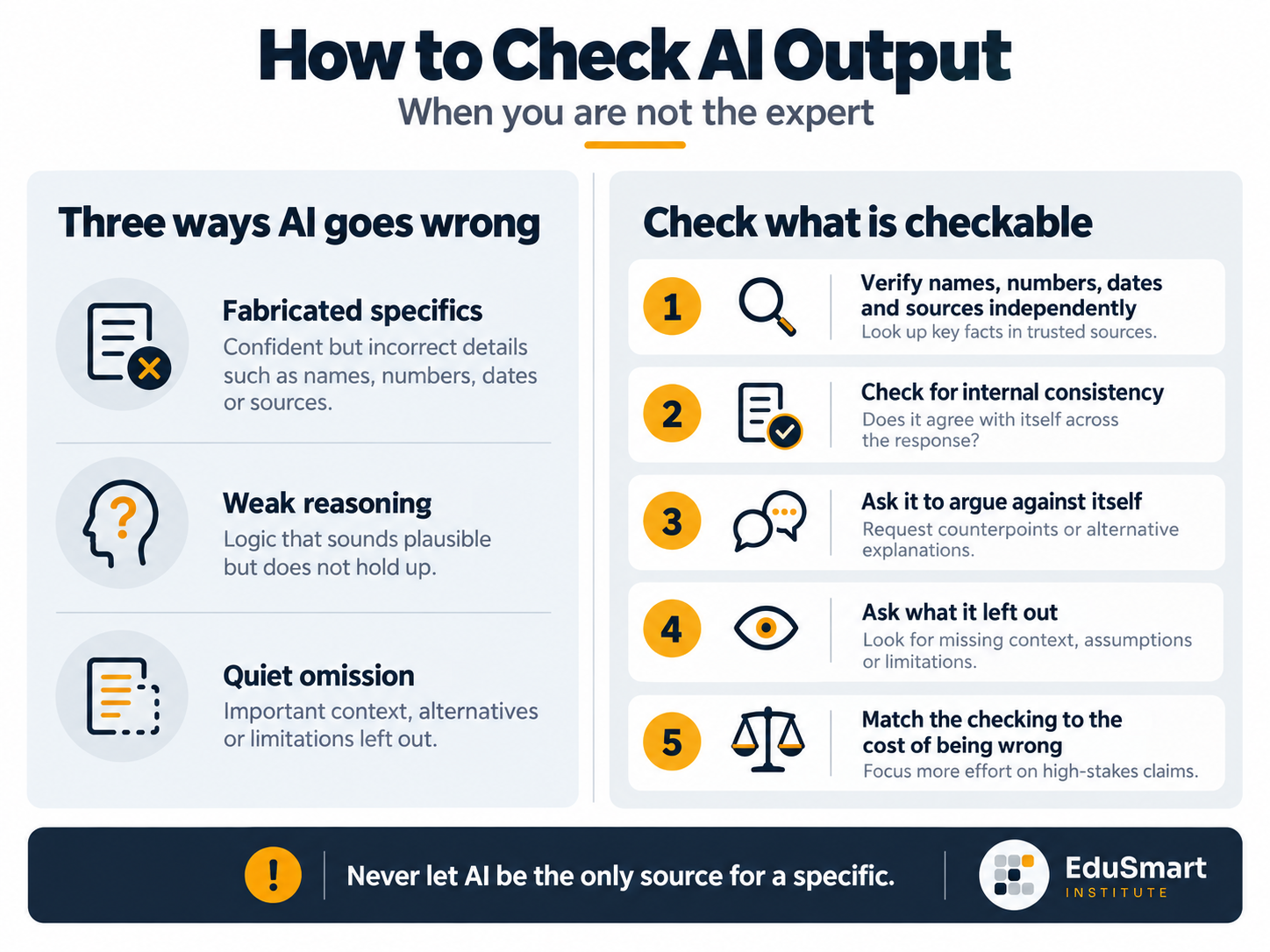
Fabricated specifics. A citation that does not exist, a section number that is not in the act, a statistic with no source, a product feature that was never built. These are the famous failure, and they are the least dangerous kind, because a specific is a checkable thing.
Reasoning that does not survive contact. The facts are broadly right, the conclusion does not follow from them, and the join is smooth enough that you nod through it. This is harder to catch because there is nothing to look up. You have to actually follow the argument.
Quiet omission. This is the dangerous one. The answer is entirely correct and leaves out the exception that applies to your situation, the step that everyone in the industry knows, the risk a specialist would have raised in the first sentence. Nothing is wrong. Something crucial is missing, and there is no blank space on the page where it should have been. You cannot catch this by reading harder, because absence does not draw attention to itself.
Most review effort goes into the first category. Most of the damage comes from the third.

Check what is checkable, even when the content is not
You cannot verify a claim in a field you do not know. You can verify quite a lot else, and it is usually enough to tell you whether to trust the rest.
Every specific gets confirmed independently. Names, numbers, dates, citations, section references, prices, legal or regulatory requirements. Not "does this sound right" — actually look it up, at the source. If a specific cannot be confirmed, treat the whole answer as unverified rather than deleting that one line. A model that invented one reference is telling you something about the rest of the response.
Read it for internal consistency. Does the number in the third paragraph match the number in the summary? Does the recommendation follow from the analysis above it, or has it quietly swapped to a different premise? Inconsistency is visible without subject knowledge, and it is a reliable sign that the output was assembled rather than reasoned.
Make it argue against itself. Ask for the strongest case that the answer is wrong, or what a sceptical specialist would object to. This is not a trick — it genuinely surfaces the counter-considerations that the first response smoothed over, and it works even when you would not have known to ask about them.
Ask what it left out. "What did you not include that someone experienced in this would consider important?" and "what would change this answer?" This is the only reliable handle on the omission problem, and it is the question people skip.
Then ask a human, if the stakes justify it. These techniques reduce the risk. They do not remove it. Knowing when to stop reviewing and start asking someone who knows is part of the skill, not an admission that the skill failed.
Match the checking to the cost of being wrong
Not everything deserves this. Applying a full review to a first-draft email is a good way to spend more time than you saved and conclude the tools are useless.
The question is what happens if this is wrong and nobody notices.
If the answer is "I look slightly silly in a meeting", skim it and move on. If it is "we give a client incorrect information", "we make a decision on a false number", "we breach an obligation" or "this ends up in a document with my name on it that someone relies on" — check every specific, follow the reasoning, and ask what is missing.
The dangerous zone is the middle: work that feels routine but feeds something consequential. A summary nobody checks becomes a briefing note, which becomes a slide, which becomes a decision. By then the original is three steps back and nobody remembers it was generated.
Never let it be the only source for a specific
A useful rule, and the one to keep if you keep only one.
Use AI to draft, structure, summarise, explain, challenge and rephrase as much as you like. Do not let it be the sole origin of a fact you are going to act on. Anything load-bearing — a figure, a rule, a deadline, an obligation — comes from a source you can point to.
That single rule removes most of the ways this goes badly wrong, and it costs almost nothing, because verifying a specific you have been handed is far faster than finding it yourself.
Write down what you checked
When you have reviewed something properly, note it: what you verified, what you could not, and what you decided to do about it. Two lines.
This matters more than it sounds. It means that if the work is questioned later, the answer is not "I assumed it was right". It also means that when your organisation eventually asks how people are handling this — and it will — you are the person with a practice rather than a habit.
Why this is the part worth learning
The models will keep getting better. Some of these failure modes will get rarer, and new ones will appear that nobody has a name for yet. What will not change is the underlying position you are in: you are accountable for work you did not personally produce, and you have to decide how much to trust it.
That is not a new problem. It is the same judgement a manager applies to a report from a junior analyst, or an editor to a contributed piece. What is new is how convincing the unreliable version looks, and how much of it there is.
Getting good at this makes you the person whose work can be relied on, whatever the tools do next, and that is what it has always come down to.
Our program builds this deliberately, on real work in your own organisation — but the habit above is worth starting on Monday, whether or not you ever study with us.