
There is a stage most people reach a few months into using AI at work. The novelty has worn off, it has clearly saved you time on some things, and you have a nagging sense that on other things it has not — that you spent twenty minutes coaxing and correcting something you could have written in ten.
You are right, and the difference between those two categories is not random. It is predictable, and once you can see it you stop wasting effort on the second kind.
The cost is the checking, not the prompting
Almost everyone accounts for this wrongly. The perceived cost of using AI is the time spent writing the prompt, which is small, so the tools look free.
The real cost is everything after: reading the output properly, verifying anything specific, noticing what is missing, fixing the parts that are subtly off, and carrying the risk of whatever you did not catch. That cost varies enormously between tasks, and it is invisible until you are already committed.
So the question is not "can AI do this?" These tools will produce something for anything you ask. The question is whether the total — producing plus checking plus fixing — comes in under what you would have spent doing it yourself.
The test: can you check it faster than you could produce it?
That is the whole thing. If verifying the output is quick, the task is a good candidate almost regardless of how complex it is. If verifying is as slow as doing the work, you have not saved anything, and you have added the risk of an error you missed.
This explains the pattern people notice but cannot articulate.
Reformatting a list, drafting an email you will read anyway, summarising a document you have to read regardless, generating variations to react to, explaining an unfamiliar concept you will then verify, writing a first draft of something you are expert in — all fast to check. You look at the output and you know immediately whether it is right.
Researching something you do not know, producing figures you would have to source anyway, drafting anything with regulatory or contractual consequence, summarising a document you will not otherwise read — all slow to check, or impossible. In several of those the only honest way to verify is to do the original work, which means the AI step added time rather than saving it.

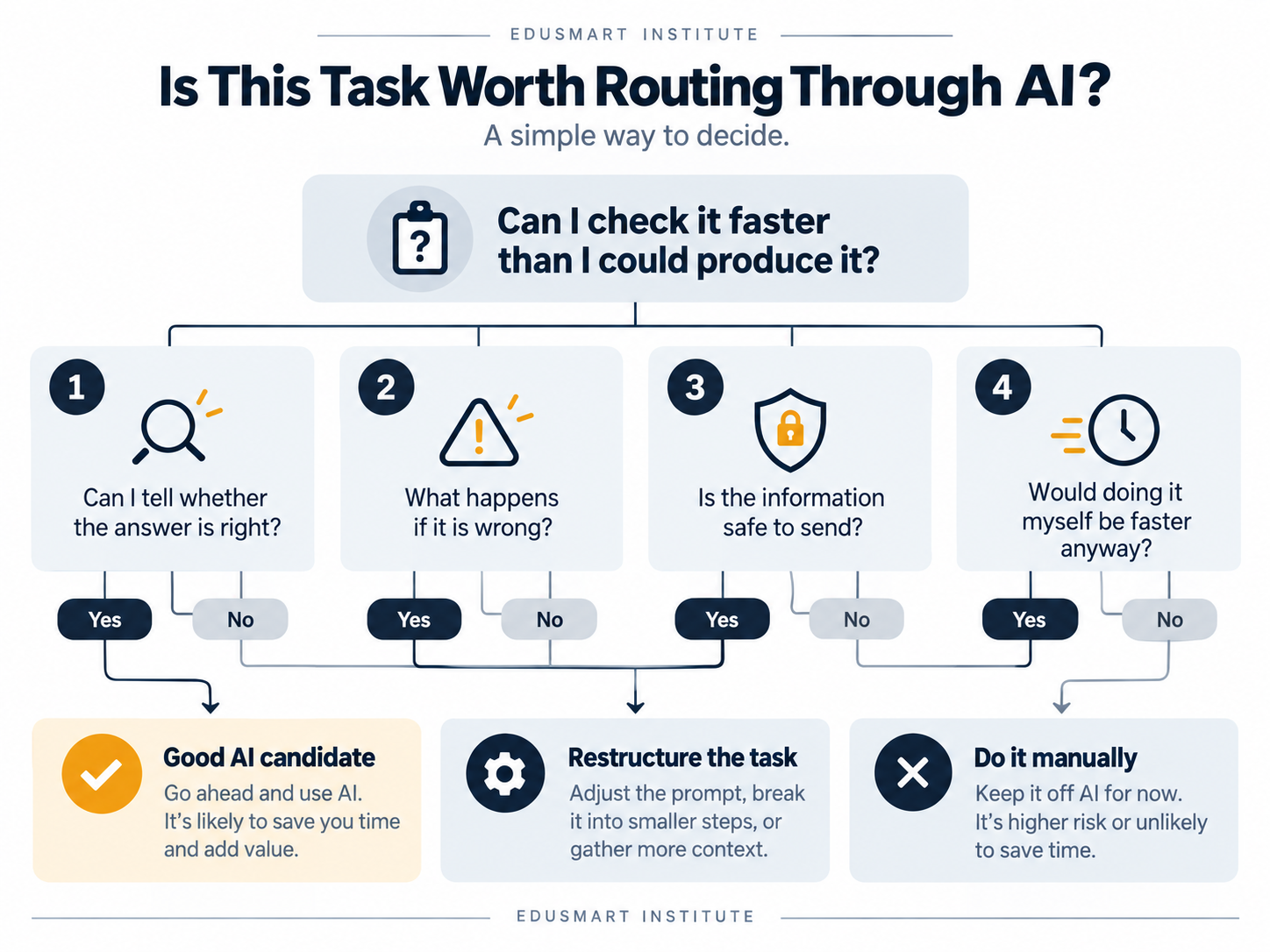
The four questions
Before handing a task over, four things settle it.
Can I tell whether the answer is right? Not "does it look plausible" — can you actually confirm it? If not, you are not delegating the task, you are just moving where the uncertainty lives.
What happens if it is wrong and nobody notices? Embarrassment, or consequence? This sets how much checking is required, which is the largest part of the cost.
Is the information safe to send? If the task only works by pasting something confidential, personal or commercially sensitive into an external system, the answer may be no before anything else is considered.
Would doing it myself have been faster anyway? For genuinely short tasks the overhead of prompting, reading and correcting frequently exceeds the work. It is worth being honest about this rather than using the tool because it is there.
If you can check it, the downside is survivable, the information is safe to send, and the task is big enough to be worth the overhead — route it. If not, do not, and stop feeling like you are behind for choosing that.
Restructure the task instead of abandoning it
A task that fails the test often passes a slightly different version of itself.
If you cannot check research output, do not ask for the answer — ask what questions you should be asking, or which sources to look at, then do the checking part yourself. You get the benefit of the thing it is genuinely good at, which is coverage of things you might not have thought of, without relying on it for facts you cannot verify.
If the blocker is sensitive information, describe the shape of the problem instead of pasting the content. An unhappy client and a two-week delay is enough context for a draft reply. The identifying details never leave.
If the risk is high but the work is repetitive, use it to draft and keep a human review step that is designed rather than assumed. Written down, so it actually happens.
The reflex worth building is not "AI or not AI". It is: what part of this is safe and cheap to hand over, and what part must stay with me? That question has a useful answer far more often than the binary one.
The trade-off moves, so revisit it
A task that failed this test last year might pass now. The models have improved, and more importantly the surrounding tooling has — being able to point a tool at your own documents changes the checking cost of a whole category of work, because now the source is one you can go and read.
So this is not a list to memorise. It is a judgement to re-run, on the tasks that matter, when something changes. The people who get this consistently right are not the ones who learned the current answer. They are the ones who kept asking the question.
Why this is the durable part
Every specific thing you learn about today's tools has a short life. Which model is best, what the interface does, which prompt phrasing works — all of it will be wrong within a couple of years, and some of it within months.
The reasoning above will not be. "Can I verify this cheaply, and what does it cost me if I am wrong" is not a fact about a product. It is how you decide whether to delegate anything to anyone, and it applies to a graduate, a contractor, a spreadsheet macro, and whatever replaces the tool you are using now.
That is the part worth getting good at, and it is the part almost nobody teaches, because it is less exciting than a list of prompts and considerably more useful.
Working this out properly on your own tasks, with someone to check your reasoning against, is what our program is built around. But you can start applying the test this week, and you should.