
There is a reasonable objection to learning about AI at all: it is moving so fast that anything you learn now will be obsolete before you have finished learning it.
The objection is half right, and the half that is wrong is the important half.
Most of what is being taught really will expire
Be honest about this, because a lot of AI training is not honest about it.
Which model is currently best will change, probably several times. The interface you learn will be redesigned. Prompt techniques that work today are being engineered away deliberately — every version that needs less careful phrasing makes the previous phrasing advice redundant. The specific limitations you learn to work around are on somebody's roadmap to remove.
A course built entirely on that material has a shelf life measured in months. If what you are being offered is essentially a well-organised list of prompts and current features, the objection stands, and you should keep your money.
What actually happened last time
We have run this experiment before, with spreadsheets, the internet, and search.
The people who learned the specific software did fine for a while and then had to relearn it. The people who learned what a spreadsheet was for — how to model something, what makes a number trustworthy, why a hard-coded value buried in a formula is a time bomb — carried that across every version and every competitor product, and are still using it.
The pattern holds. Tool knowledge decays. Judgement about the class of tool compounds. What is different this time is only the speed, which makes the distinction more valuable, not less.

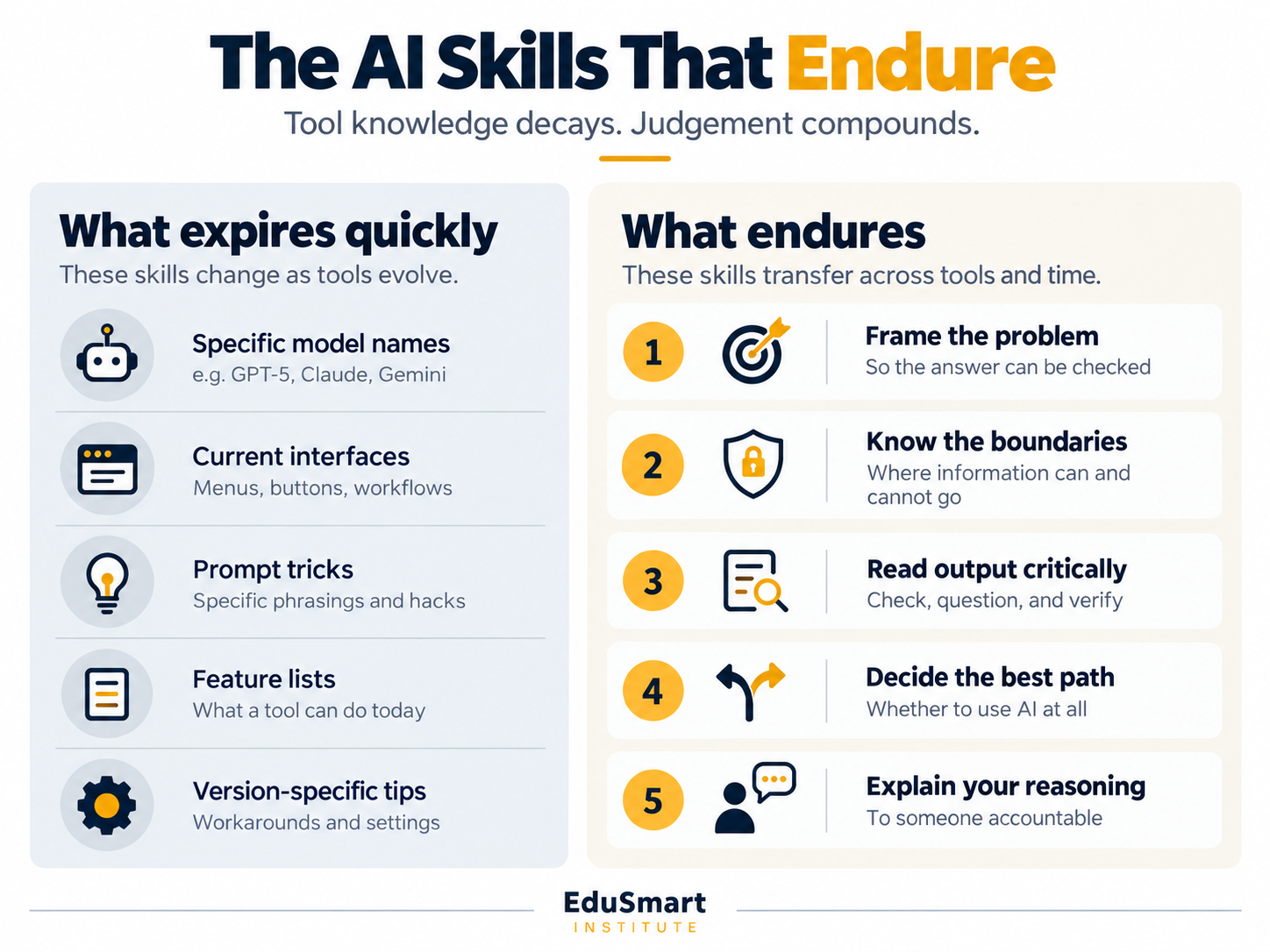
The five that hold
Strip away everything version-specific and this is what remains.
Framing a problem so the answer can be checked. Most poor results come from asking in a way that makes verification impossible. Learning to break a request into pieces you can confirm is a thinking skill. It survives every tool change, and it is most of the difference between people who get good results and people who do not.
Knowing where information can and cannot go. Which data can leave the organisation, what your obligations actually are, how to get help on a real problem without exposing what makes it real. This is about your organisation's risk position, not the product, and it applies identically to whatever tool arrives next.
Reading output critically. Recognising that fluency and accuracy are unrelated. Knowing the failure modes — invented specifics, reasoning that does not follow, and the quiet omission that is the most dangerous of the three. Knowing to check the checkable and to ask what was left out. Models get better at some of this and worse at making it visible.
Deciding whether to route the task at all. Weighing what you save producing against what you spend checking, and against the cost of an error nobody catches. This is delegation judgement. It applies to a graduate, a contractor, a script, and every tool that has not been built yet.
Explaining your reasoning to someone accountable. Being able to say why you used it here and not there, what you verified, and what you decided to carry. This is what makes someone trusted with a technology rather than supervised around it, and it is entirely independent of which technology.
None of those are about AI. That is exactly why they last.
Why they compound instead of decaying
Tool knowledge is replaced. Judgement accumulates.
Every time you decide whether to hand a task over and then find out whether you were right, your sense of where the line sits gets sharper. Every time you catch an error you might have missed, you learn something about how these systems fail that transfers to the next one. Every time you explain a decision to someone who pushes back, your reasoning improves.
That is a stock that grows, and it grows whether or not the underlying tools stand still — arguably faster when they do not, because change gives you more decisions to make.
It is also the part that is visible to the people you work with. Nobody notices which model you used. They notice whether your work holds up.
How to build it without waiting for a course
You do not need permission or a budget to start.
Pick real work rather than exercises. The judgement only develops against genuine stakes — a task where being wrong actually costs something teaches you more than any number of worked examples.
Write down what you decided and why, before you find out. Which tasks you routed, what you checked, what you deliberately did not hand over. When it goes wrong you will know which part of your reasoning failed, which is the only way the reasoning improves.
Deliberately get it wrong somewhere safe. Push a task you suspect is a bad candidate and watch how it fails. Understanding the failure modes from the inside is worth more than being told about them.
Talk to someone about it. The reasoning gets tested when you have to defend it, and most workplaces currently have nobody doing this out loud, which is an opening rather than a problem.
The honest version of the objection
So: will what you learn go out of date?
If you learn tools, yes, and quickly. If you learn how to think about the tools — how to frame, where the risk sits, how to check, when it is worth it, and how to explain the call you made — then no, because none of that is a fact about a product that a new release can invalidate.
The second kind is harder to teach and harder to sell, because it does not fit on a feature list and it cannot be demonstrated in a two-minute video. It is also the only part that is still worth anything in five years.
That is the part our program is built on: real problems in your own workplace, decisions you have to defend, and evidence of what changed. Not a list of prompts, which would be out of date before you finished reading it.