
If you work in sales, your value is a number and the argument is short.
Most people do not work in sales. You keep things running, fix problems before anyone notices, hold a process together, keep a difficult relationship healthy. It is real work and it is hard to point at, which is why performance reviews so often turn into a list of activities and a hopeful tone.
The problem is not that your work has no value. It is that nobody has written the value down, and by the time you need it, the year has gone.
Here is how to fix that.
The problem with "I improved the process"
Read that sentence as a manager would. It says something happened, somewhere, of unknown size. There is nothing in it to weigh, so it gets a nod and no more.
Now read this one: "Onboarding a new client used to take eleven days and four people. It now takes four days and two, because the three approval steps that were waiting on each other now happen at once."
Same work. The second version can be assessed by someone who was not there. That is the entire difference, and it is not a difference of writing skill. It is a difference of what you wrote down while it was happening.
Start from what it was costing, not from what you did
The instinct is to describe your solution. Start one step earlier.
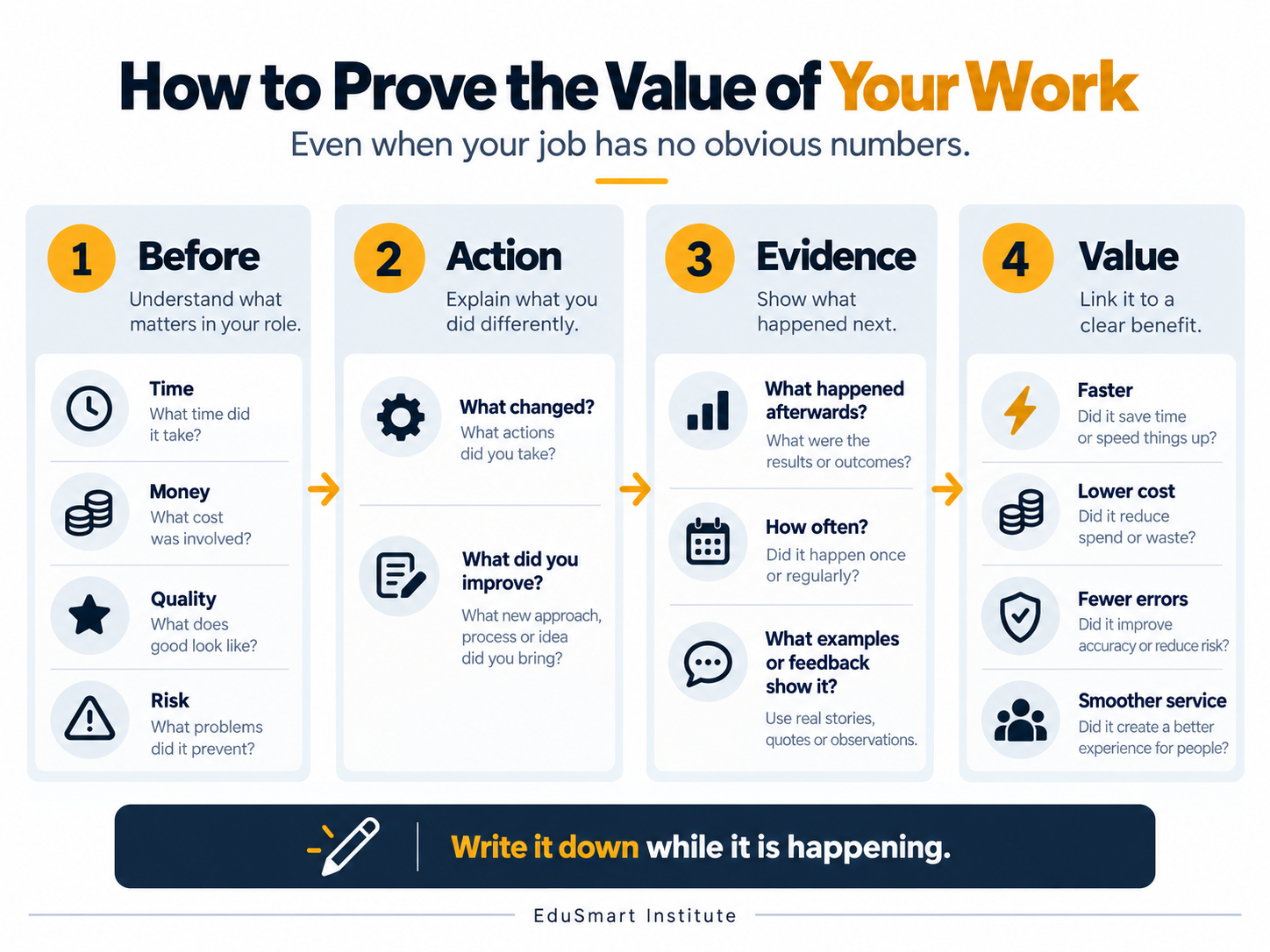
Every piece of improvement work begins with something the organisation is already paying for: time somebody spends, money going out, quality problems that get fixed later, or a risk being carried. That cost is what makes the work worth doing, and it is the thing your manager already understands.
So before the fix, name the cost.
- Time. How long does it take, how often, and how many people?
- Money. What is actually being spent, or written off, or paid twice?
- Quality. How often does it come back, get reworked, or get complained about?
- Risk. What could go wrong, and what happens when it does?
Most work you would want credit for sits in at least one of those. Naming which one turns "I improved the process" into a claim with a unit attached.

The "before" is the hard part, and you can still get it
The usual objection: nobody measured what it was like before, and now it is too late.
It is less late than you think. You are not producing an audited figure. You are producing an honest, checkable estimate, and there is almost always something to build one from.
Ask the people who do the work — "roughly how long does this take you, and how often?" is a question most colleagues can answer within a reasonable margin. Look at what the systems already record: dates on tickets, timestamps on emails, dates on invoices, the gap between a request and its completion. Count a sample rather than the whole year. Twenty cases will tell you what you need.
Then write the estimate down with its reasoning attached: "Based on twenty files from March, the average gap between request and approval was six days. Three of the four staff involved estimated they spent 40 minutes per file chasing it."
That is not a soft number. It is a number somebody can check, which is the only property that matters.
Measure the same way afterwards
This is where most people lose the argument they had already won.
Whatever you counted before, count it the same way after. Same sample size, same definition, same source. If you estimated from twenty files in March, estimate from twenty files in September. If you change the method between the two, you have not measured a change — you have produced two unrelated numbers, and anyone reading carefully will notice.
Give it long enough to be real. A week after go-live tells you people are being careful. Two months tells you what it is actually like.
Write it down while it is happening
You will not remember this in eleven months. Nobody does.
Keep one file. Every time you finish something worth remembering, add five lines:
- what the problem was, and what it was costing
- what you changed
- what it is like now, measured the same way
- what you decided against, and why
- who else was involved
That fourth line is worth more than people expect. Anyone can describe a solution. Someone who can explain the two options they turned down and why is demonstrating judgement, which is the thing being assessed when a bigger job is on the table.
Ten minutes, at the time. That is the whole discipline.
What it looks like when someone else reads it
Here is the difference this makes.
Without the record, your review is a conversation about impressions. You say the year went well, your manager agrees, and the discussion moves to whether the budget allows anything. Your case rests on your manager's memory and their willingness to advocate for you.
With the record, your manager has something open in front of them: a problem that was costing the business, what you changed, what it did afterwards, and your reasoning. They are not being asked to take your word for anything. They are reading the work.
That is a different conversation, and it is different in a specific way. It stops being about whether you deserve something and starts being about what the business got. The second question is much easier for someone to say yes to, and much easier for them to repeat to their own manager when you are not in the room.
Start with one
Do not go back through the year. Pick the thing you are working on now, and write the "before" this week, while you still can.
One properly documented improvement is worth more at review time than a page of responsibilities, because it is the only part anyone can verify. And once you have done it once, you will not go back to the other way — the habit costs almost nothing and it compounds, quietly, into a record of exactly what you are worth.
Building that record deliberately, on real problems in your own workplace, is what our program is for. But the habit works whether you study with us or not, and you can start it on Monday.