
Most advice about AI and your career is some arrangement of the same three sentences. The world is changing. You should be curious. The future belongs to those who adapt.
None of it is wrong. None of it tells you what to do on Monday, and none of it engages with the thing people are actually worried about, which is usually not what they say out loud.
So this is the longer answer, and it starts by moving the question.
The fear is pointed at the wrong thing
Almost everyone frames this as will my job be replaced. Whole jobs are rarely the unit that changes. Tasks are.
A job is a bundle of a few dozen tasks. Some of them are now much cheaper to do than they were, some are not, and the ones that got cheaper are not distributed evenly across the bundle. What happens is not that the job disappears. It is that the bundle gets re-cut, and the version that comes out the other side weights different things.
This matters because it changes what you should be watching. Not "is my occupation on somebody's list" — that question has no useful answer and it is asked mostly to be frightened by. The question is: which of the things I spend my week on just got cheap, and what is left when those are gone?
For most people the honest answer is that what is left is the harder part. Deciding what should be done rather than doing it. Judging whether an output is any good. Handling the situation the process does not cover. Carrying the responsibility when it goes wrong. Those are the residue, and the residue is where the value concentrates.
That is not a reassuring answer, because the residue is more demanding than the bundle was. But it is a much more actionable one.
"Behind" is measured against the wrong scale
The other common feeling is that everyone else has raced ahead and you have missed something.
Watch what people mean when they say it. They mean other people know the tools and they do not — which model to use, what the settings do, the prompt phrasings that get better results.
That knowledge is real, and it is also the least durable thing in this whole field. It takes a couple of weeks to acquire, it is being actively engineered away with every release, and someone who learned it eighteen months ago has already had to relearn most of it.
Being "behind" on tools is a small, closing distance. Being behind on judgement is a large, widening one, and almost nobody frames their anxiety that way — which is lucky, because it means the thing that matters is not what everyone is racing at.

The four things that actually decide it
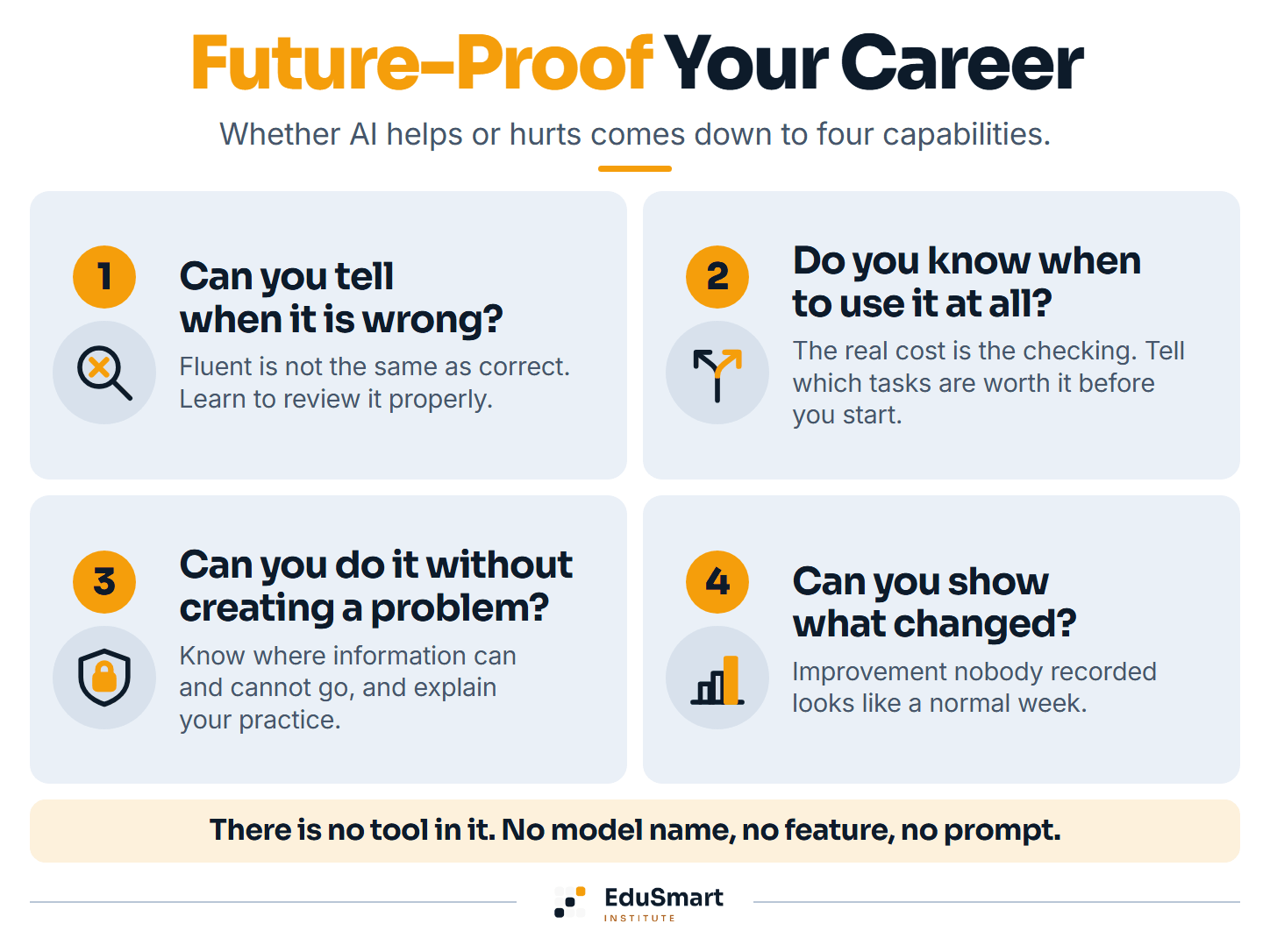
Strip out the noise and the question of whether AI helps or hurts your career comes down to four capabilities. None of them is about a product.
Can you tell when it is wrong? These systems produce confident, fluent, well-organised output whether or not it is correct, and every instinct you have for judging competence by fluency is now unreliable. The errors that hurt are not the invented citations everyone talks about; they are the answers that are entirely correct and quietly leave out the thing that mattered. Learning to review properly — including in subjects you do not know — is the single highest-value skill in this list. How to check AI output when you are not the expert goes through it properly.
Do you know when to use it at all? The cost of using AI is not the prompt, it is the checking, and that cost varies enormously by task. Some work is fast to verify and worth handing over immediately. Some cannot be verified without doing the original work, which means the AI step added time and risk rather than removing them. Being able to tell which is which, before you start, is most of the difference between people who genuinely save time and people who feel busy. Is this task worth routing through AI? sets out the test.
Can you do it without creating a problem? Most workplaces have staff using these tools and no policy covering it. Having no policy is not neutral: it means individuals are making information-handling decisions on their own, usually without having read what they already agreed to. Knowing where information can and cannot go, and being able to explain your practice, is what separates being trusted with this from being watched around it. What to do when your workplace has no AI policy covers the practical version.
Can you show what changed? This is the one people skip, and it is the one that decides whether any of the rest is visible. Improvement that nobody recorded is indistinguishable from a normal week. How to prove the value of your work when your job has no numbers is the method.
Read that list again and notice what is absent from it. There is no tool in it. There is no model name, no feature, no prompt. That is not an oversight — it is the point. The AI skills that do not expire when the model does makes the longer argument for why.
What you do not have to do
It is worth saying plainly, because a lot of energy goes into these.
You do not have to learn to code. You do not have to understand how the models work internally. You do not have to try every tool that launches, keep up with the news cycle, or have an opinion about which company is ahead. You do not need a certificate in a specific product, most of which describe an interface that will have changed.
If keeping up feels like a treadmill, it is because you are standing on the part that moves. Step off it. The part that does not move is the four capabilities above, and they are learned by doing real work carefully, not by consuming more content about AI.
Where to start this week
Concretely, and in this order.
Pick one real task you already do, that you can check, and where being wrong is survivable. Not a demonstration — actual work with actual stakes. Route it, then review the output properly rather than skimming it.
Write down what you decided and why before you find out whether it worked. Which parts you handed over, which you kept, what you checked. This is the difference between accumulating experience and accumulating hours.
Read what you already agreed to. Your confidentiality clause, the acceptable use policy, whatever governs your industry. Twenty minutes, and it answers most of the "am I allowed to" anxiety permanently.
Measure one thing before you change it. Anything. How long it takes, how often it comes back, what it costs. You will want the "before" later and you cannot reconstruct it.
Then repeat, on something slightly harder. Judgement is built from decisions that turned out to be right or wrong, and there is no shortcut that skips the finding-out.
The honest position
Nobody can tell you your job is safe, and you should distrust anyone who does. What can be said is more specific and more useful.
The part of your work that was easiest to describe is the part that got cheapest. What is left is the judgement, the accountability and the ability to show what you changed — and those are learnable, they compound, and they are visible to the people who make decisions about you.
That is a better position than the one the headlines describe, and it is available to you regardless of your role, your age, or how far behind you currently feel.
Building that deliberately, on projects inside Next Horizon, a simulated organisation, with the evidence to show for it, is what our program is for. But every one of the steps above works on its own, and none of them requires you to enrol in anything.